Testament, sculpted by John and Kathy Deering to commemorate the nine students who entered Little Rock Central High School in their battle for civil rights for all Americans. Those nine courageous students were Minnijean Brown, Elizabeth Eckford, Ernest Green, Thelma Motherhead, Melba Pattillo, Carlotta Walls, Terence Roberts, Jefferson Thomas, and Gloria Karlmark.
Little Rock Central High School
In 1957, Little Rock's Central High School became a battleground in the struggle for civil rights. The nation sat transfixed as nine African-American students entered the previously all-white school under federal troop escort. With the help of television news, the events captured worldwide attention. Little Rock came to symbolize our commitment to eliminating separate systems of education for blacks and whites.
Under federal court order, the Little Rock School District prepared to admit nine African-American students to Central High. On September 2, 1957 Arkansas Govenor Orval Faubus announced his intent to use Arkansas National Guard to "prevent violence" and prohibit the nine students from entering school. On September 4, the students attempted to enter school and were turned away by troops.
Much of the press coverage that day centered around Elizabeth Eckford who found herself alone in the midst of an angry crowd.
"I tried to see a friendly face somewhere in the mob - someone who maybe would help. I looked into the face of an old woman and it seemed a kind face, but when I looked at her again, she spat on me." All nine were denied entry to the school for the next two weeks.
The school board requested a suspension of its desegregation plan but this request was denied by Federal District Court Judge Ronald Davies. Six days later, Judge Davies ruled Faubus had not used the Arkansas National Guard troops to preserve the law and ordered them removed.
Little Rock police tried to maintain order as the nine students finally entered the school. The police lost control of the rioting crowd and the nine students had to be quickly smuggled out the back door of the school for their own safety.
President Eisenhower called the rioting "disgraceful" and ordered the Army into Little Rock and federalized the Arkansas National Guard. On September 25, under federal escort, the Little Rock Nine enter Central High School for their first full day of classes. The federal troop presence remained throughout the school year at Central. On May 25, 1958, Ernest Green, the only senior, became the first African-American graduate of Central High School.
Buses ready to pick up students after school. Today 53 percent of Central High students are African-American.
We took a tour with a group of students from Florida presented by the National Park Service. Because Little Rock Central High School is also a National Historic Site it is maintained by the parks department.
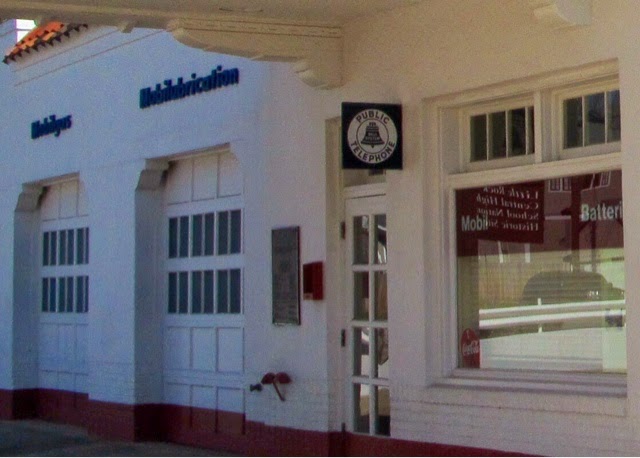
Magnolia Mobile Service Station
The media gathered at the Magnolia because it sits directly across the street from Central High School and was one of the few businesses in the area, plus it had a pay telephone. Reporters from around the world could call in the news of the day.
"...the world media took a moral stand on Little Rock and they were horrified...there was so much media coverage, even though we knew (the people in the crowd) were crazy we also knew that they would have to be really crazy to kill one of us in public." Minnijean Brown
The Old Mill
The Old Mill is at T.R. Pugh Memorial Park. In 1931, it was built to appear to be an abandoned old water-powered grist mill as a tribute to Arkansas pioneers. Dionicio Rodriguez, a sculptor and artist, did all the detail of each piece of concrete made to represent wood, iron, or stone as well as designing the foot bridges and rustic seats.
The Old Mill appears in the opening scenes of Gone With the Wind and is believed to be the only remaining structure from the movie.
Good EATS
Scott in Scott, Arkansas!
Cotham Mercantile sits precariously over the bayou in Scott.
Careful, don't step right through the front porch! All of the restaurants pictured in this section are featured in the book, Roadfood by Jane and Michael Stern and to be honest I wouldn't have set foot inside without their recommendation! But as the old saying goes - don't judge a book by its cover!
The shelves are packed with vintage house and farm treasures including Hitler's mustache! What a hoot! Scott and I had lunch here and it was packed with farmers, housewives, legislators, business men and women, and tourists, like us! Incredible...
Dinner at Doe's Eat Place means STEAK, order by the pound; skillet-cooked French fries, new potatoes, and marinated house salad round out the meal. Scott's dream come true - steak and 2 kinds of potatoes! Delicious!
80 year old Mary Thomas (she just had a birthday 2 weeks ago) has been making pies from the
Family Pie Shop in DeValls Bluff since 1977, before that she sold them from across the street at Craig's Bar-B-Que, and does she ever know how to make a great pie crust! Bill Clinton liked to come here - when asked what kind of pie he liked, she replied, "He liked them all!" The local man who dropped by while we were there said to try chocolate or lemon. We ended up buying coconut cream with a wonderful meringue on top! And 3 fried peach pies! Oh yah!
William J. Clinton Presidential Center


Scott taking charge in the Cabinet Room, a full-size replica of the White House Cabinet Room.
Full-scale reconstruction of the Oval Office shows the room and its furnishings as they appeared during the Clinton administration.
The Presidential Seal was officially selected by President Harry S. Truman. The eagle holds the arrows of war and the olive branch of peace in his talons but he always faces the olive branch. There are 13 stripes on the shield representing the 13 original colonies and the stars represent the 50 states.
In this room is a time-line of Clinton's administration. Notice the blue archive boxes filled with White House correspondence. These documents represent only 3 percent of the 80 million pages of documents in the Clinton archives.
Crystal Tree of Light by Dale Chihuly for the millennium Christmas celebration at the White House.
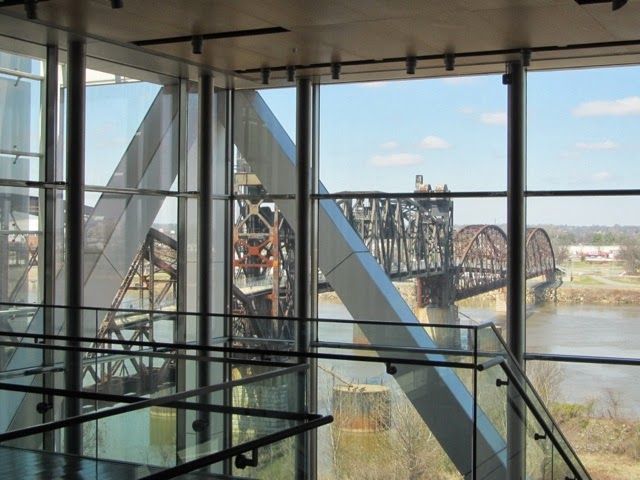
Looking out on the Clinton Presidential Park Bridge, an old railroad bridge turned pedestrian walkway over the Arkansas River.
Clinton Presidential Park
Clinton Presidential Park Bridge
We were in Little Rock on St. Patrick's Day and that night all the bridges over the Arkansas River were green!